

Quarterly Market Review: July 2025
July 1, 2025
One Big Beautiful Bill Act Planning Strategies
September 1, 2025
By Bradley Miller
We strive to have all of our clients globally invested across various assets classes, both within the United States and the rest of the world. While markets tend to ebb and flow, we want to ensure that we are not tied to the performance of one single market or region. Spreading out country risk, political risk, and currency risk are just a few benefits of global diversification. Below, we will discuss recent trends and provide a historical perspective on U.S. equities compared to international equities.
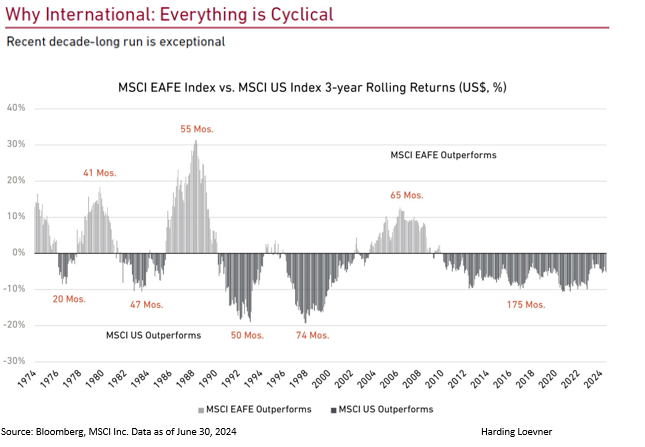
For the better part of a decade, we have seen outperformance for U.S. stocks compared to international stocks. Since the 2008 global financial crisis, the U.S. has mounted a faster recovery and tended to produce stronger earnings compared to international companies. A strong dollar has helped to facilitate this outperformance – conversely, the same strong dollar has hurt international investing.
The below chart helps to illustrate how far the pendulum has swung in favor of the United States since around 2010. The light gray bars above the line show periods where international markets outperformed U.S. markets. The dark gray bars below the line show periods when U.S. markets outperformed international markets. Generally, outperformance flip flops between international and U.S. stocks. What we have seen recently is unprecedented – the most recent outperformance has lasted more than double any prior cycle of outperformance in the past 50 years.
We do not believe one has the ability to perfectly “time markets”. While a perfect entry point may not look apparent till afterwards – at that point it is too late; we want to ensure that our clients’ portfolios have adequate exposure to these international markets especially at current prices and valuations. This year, we have seen a run up in international markets compared to the United States – is this a sign of the turnaround, only time will tell. Current vaulations of most U.S. companies are historically high and we believe now is a good time to reevaluate the role of international stocks in our clients’ portfolios.
From a population standpoint, the United States makes up less than 5% of the world’s population, meaning 95% of people reside outside the U.S. Similarly, 75% of the world’s GDP comes from outside of the U.S. Missing out on exposure to companies such as Samsung (South Korea), Alibaba (China), or Louie Vuitton (France) would be ill-advised. By spreading out country specific risk, this lessens the impact of political or economic turmoil for a certain region. We see technology companies dominate in Taiwan and South Korea; luxury goods come from Switzerland and France, Natural Resources from Canada and the United Kingdom, Automotive companies from Germany and Japan, that all cover different corners of the global market which we want to have exposure to.
Additionally, currency diversification is another positive that helps to spread out risk. Given the spending of our U.S. government, we want to have additional exposure for our clients outside of the dollar. If the U.S. dollar were to weaken, this would help to increase returns for international currencies when converted back to the dollar.
This isn’t to say that we are “all-in” on international markets. Rather, we want to ensure we aren’t overly exposed to U.S. markets given that they are currently at all-time highs and take advantage of opportunities around the world that are possibly undervalued. Some investors have a natural “home bias” and may not consider having international exposure. We provide diversification to our clients by intentionally having funds that invest in international companies.
As always, please don’t hesitate to reach out to us directly to discuss your portfolio or any other questions that come to mind!